The EcoFlow Delta 2 has been one of the most recommended 1,000 Wh power stations for years, which is exactly why it deserves a sceptical look. Is it still a smart buy, or just a familiar name?
I bought this one at retail and have used it for camping, as a home office backup and through a couple of outages. Below is what that taught me, with the manufacturer's published specifications clearly labelled as such.
The specs that matter
Manufacturer figures:
- Capacity: 1024 Wh
- Cell type: LiFePO4, rated around 3,000 cycles to 80% capacity
- AC output: 1800W, with surge headroom well above that
- Solar input: up to 500W
- Fast charging: to roughly 80% in under an hour from the wall
On paper it hits the three things I tell people to insist on: a sensible 1 kWh capacity, long-life LFP chemistry, and an inverter strong enough for most heating appliances. That alone puts it ahead of plenty of cheaper units still shipping older chemistry — the reasoning behind those three priorities is in the portable power station buying guide.
What holds up
The chemistry, and what it means for lifespan
LiFePO4 at this price was the headline when it launched and it's still the reason to consider it. Cycle life is the spec that decides whether you're buying something for two years or ten, and this is firmly in the second camp. Mine shows no capacity change I can detect in normal use.
Charging speed you actually notice
The wall-charge speed is the feature I've come to rely on most. Forgetting to top it up before a trip used to mean postponing the trip; now it means waiting through a coffee. It's the kind of specification that sounds like marketing until it saves you once.
Enough output to stop thinking about output
1800W covers a coffee maker, a microwave, or most power tools a 1 kWh unit could realistically sustain. In practice I've never been limited by the inverter — I run out of battery first, which is the right way round.
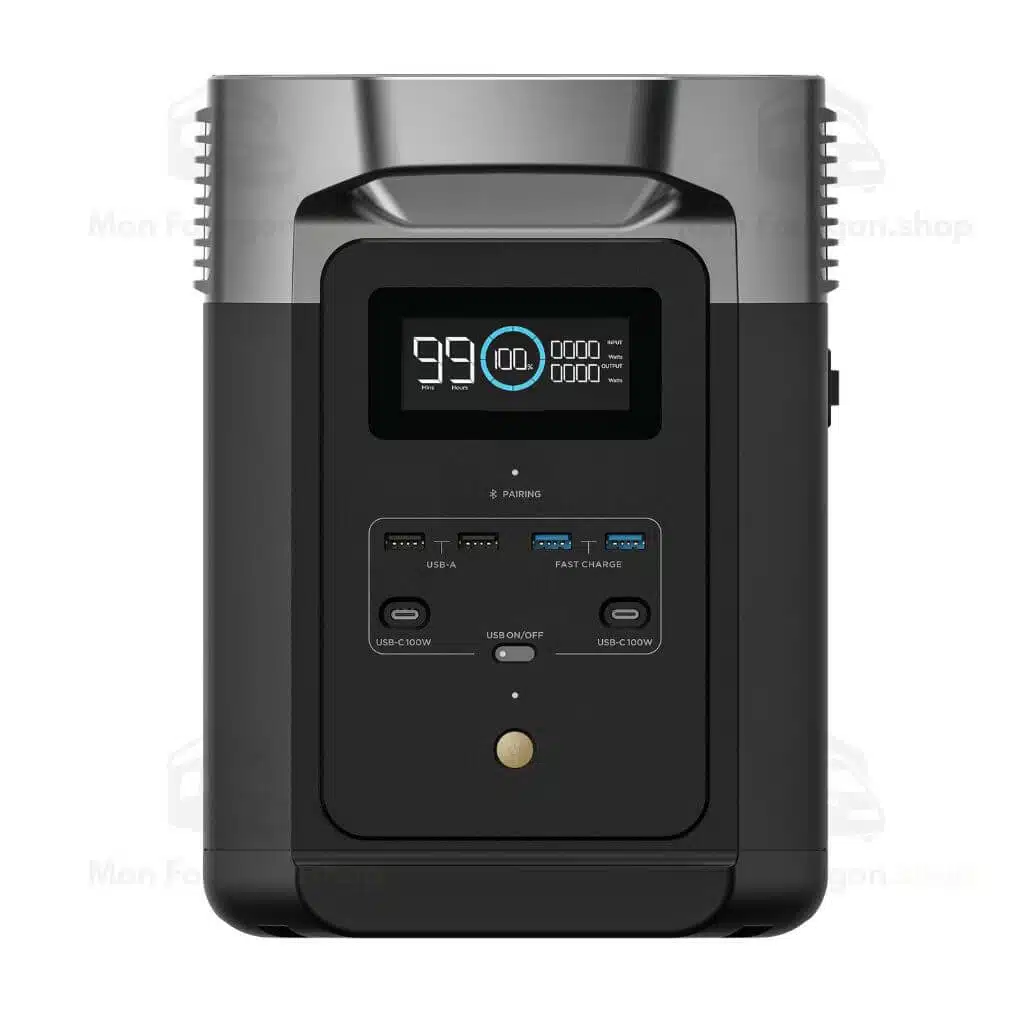
EcoFlow Delta 2
What I liked:
- 1,024 Wh and 1,800W: the combination that made this the default 1 kWh recommendation for years
- LiFePO4 cells rated around 3,000 cycles to 80% capacity, back when rivals still shipped lithium-ion
- Wall charging to roughly 80% in under an hour
- Mature app and ecosystem, with an expansion battery available to double capacity
What let me down:
- Owners consistently report audible fan noise when fast charging or under heavy load
- Around 27 lb, so it is a two-hands carry
- Newer 1 kWh units have matched or beaten it on solar input and noise, so it is only a buy when discounted
Where to buy it for the best price
What to be honest about
The fans
This is my main complaint. They ramp up and are clearly audible when charging fast or running a heavy load. In a living room it's unremarkable; in a small van or a bedroom at night it's the thing you'll notice. If sleeping beside it matters to you, weigh this properly.
Weight
At around 27 lb it's portable in the carry-it-to-the-car sense, not the carry-it-far sense. That's normal for the capacity, but don't picture something you'll sling over a shoulder.
It's no longer the automatic answer
Newer 1 kWh units from Anker, Bluetti and others have narrowed or closed the gap, some with more solar input or quieter operation. The Delta 2 is no longer the default recommendation it once was, which changes how you should buy it — see below.
Who it's for
- Good fit: you want a proven, well-supported 1 kWh LiFePO4 unit with genuinely fast charging for home backup, van life or camping, and you find it discounted.
- Look elsewhere if: you need the quietest possible unit to sleep beside, or a newer model matches it on price while beating it on solar input.
Verdict
The Delta 2 is a solid, sensible choice rather than a standout. The fundamentals I care about — LFP chemistry, real output, fast charging — are all here and all still competitive.
What's changed is the field around it. So buy it on price: meaningfully cheaper than a comparable newer unit, it's a smart pick; at parity, compare carefully. That's a genuinely different conclusion from "this is the one to buy," and it's the honest one.
Not sure a 1 kWh unit is even the right size? Start with the buying guide, or put your own appliances through the runtime calculator. To see how it sits against the alternatives, browse my other portable power station reviews or the wider portable power station guide. How the score above is built is explained in how I rate products.