If you've watched a single off-grid or van build video, you've seen a Renogy 100W panel. It became the default 12V DIY panel almost by inertia — which is precisely why it's worth checking whether it's genuinely the right pick or just the familiar one.
I bought these panels and wired them into my own builds. Here's what that's worth knowing, with the manufacturer's specifications labelled as such.
What it is
- Rated power: 100W, the standard building block for 12V DIY systems.
- Type: monocrystalline, the more efficient of the common panel types.
- Voltage: 12V nominal, easy to wire in series or parallel for larger arrays.
- Build: aluminium frame and tempered glass, designed to live outdoors for years.
- Ecosystem: sold alongside matching controllers, brackets and complete kits.
What makes it a safe default
The ecosystem does the hard part
This is the real strength, and it's not about the panel. Panels, MPPT controllers, mounts and complete kits are easy to buy together, with consistent mounting patterns and documentation aimed at first-timers. On a first build, that removes most of the opportunities to make an expensive wiring mistake — which is worth more than a few watts.
A format everything else assumes
A 100W 12V mono panel is the unit the entire DIY world plans around. Guides, calculators and kit designs assume it, so it drops into almost any plan without surprises, and you can add to an array over time without rethinking it.
It survives being ignored
Mine have been bolted down and forgotten through full seasons outdoors with no degradation I can see and no water ingress at the junction box. For something you install once and then stop thinking about, that's the property that matters.
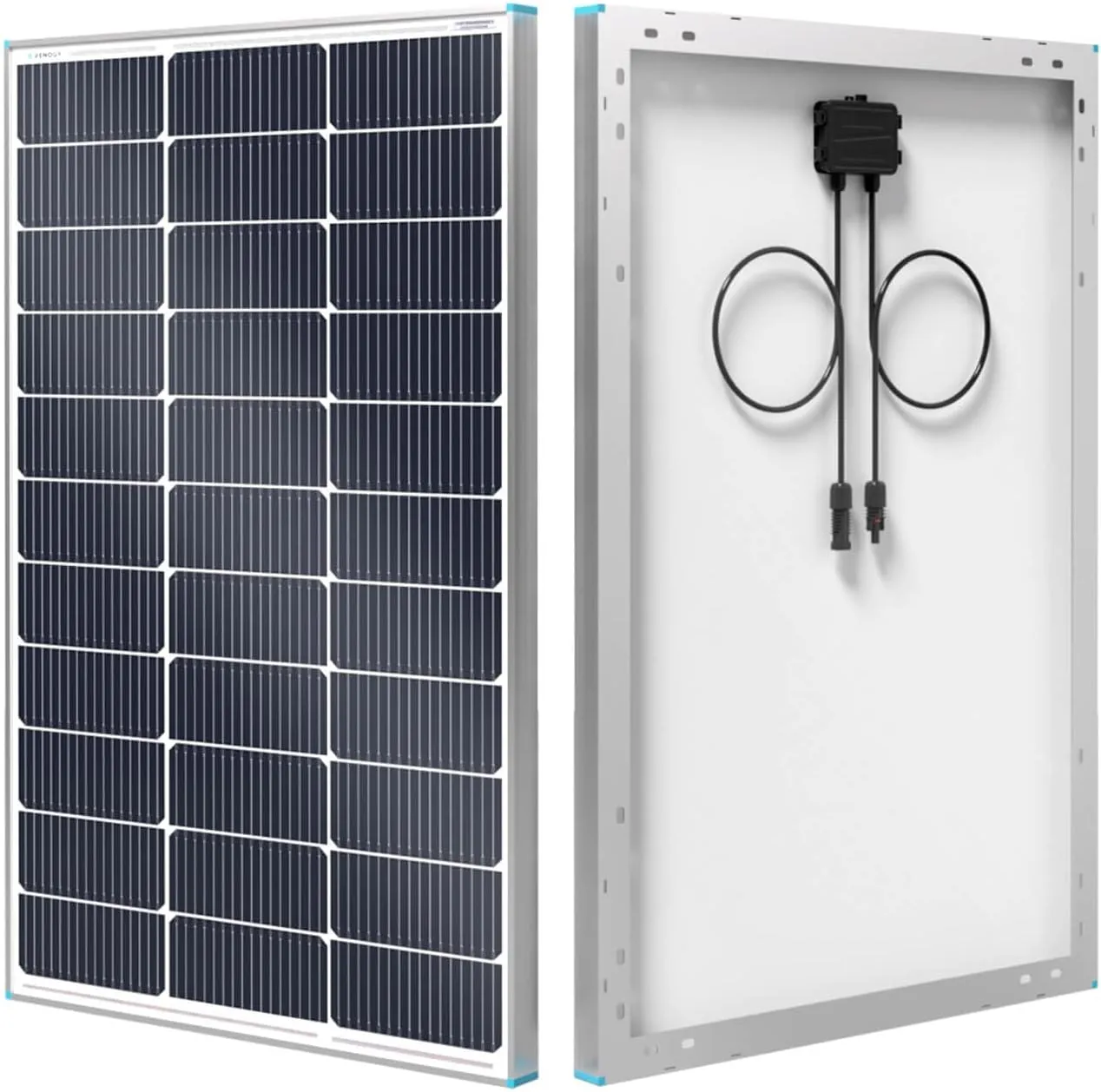
Renogy 100W 12V Solar Panel (N-Type)
What I liked:
- The default DIY building block: 100W at 12V is the unit almost every off-grid tutorial is written around
- Current N-Type 16BB cells rated around 25% efficiency, a real step up from the older PERC version
- IP67 junction box and an aluminium frame built for years on a roof or a trailer
- Cheap and abundant enough that scaling to 200W, 400W or more is just buying more of the same panel
What let me down:
- 100W realistically returns 300-500 Wh on a good day, so the panel count climbs quickly for real loads
- Rigid and framed: heavy and awkward next to flexible or folding panels
- Sold bare, so brackets, cabling and a charge controller are all extra
Where to buy it for the best price
What to be honest about
You pay a premium per watt
This is the main caveat. Because of the brand and ecosystem, you generally pay more than for generic or larger-format panels delivering more watts per dollar. If raw cost-efficiency is your priority, you can do better.
100W is small once you scale
For a serious cabin or a full-time van, you'll need several. Larger single panels mean less mounting hardware, fewer connectors and less wiring for the same total wattage — and every connector is a small loss and a potential failure point. The 100W size is convenient for small builds and works against you at scale.
Part of what you're buying is the name
The ecosystem genuinely helps beginners. If you're comfortable matching a generic panel to your own controller, you're paying for reassurance you don't need.
Who it's for
- Good fit: a first-time DIY builder who wants a proven, well-documented panel that drops into a matching kit with minimal guesswork.
- Look elsewhere if: you're cost-focused or building a large array, where cheaper or larger-format panels give more watts per dollar and per bracket.
Verdict
The Renogy 100W is still a safe, sensible default, especially for beginners who want everything to fit together and simply work. The panel is a standard, durable mono unit, and the ecosystem around it genuinely reduces mistakes on a first build.
What it isn't is the best value per watt. If you're experienced or building big, shop on price per watt and you'll usually do better. If you're starting out, it earns its place — and the money you don't lose to a wiring error covers the premium.
Either way, size the system before buying panels: use the off-grid solar sizing guide, and pair it with the right controller via MPPT vs PWM. More component verdicts are in my off-grid gear reviews, the wider picture is on the off-grid solar hub, and the scoring method is in how I rate products.