The charge controller is the least glamorous part of a DIY solar setup and the one people get wrong most often. The whole debate comes down to two letters: MPPT or PWM. Get it right and you harvest more of your panels' output for years. Get it wrong and you either waste power or waste money.
Here is the honest version, without the forum tribalism.
In one sentence
Use MPPT for anything but the smallest systems, especially when your panel voltage is higher than your battery voltage. Use a cheap PWM only for tiny, low-cost setups where the panel and battery voltages already match closely and every dollar counts.
What each one actually does
A charge controller sits between your solar panels and your battery, and its job is to feed the battery safely. The difference is how they handle the gap between panel voltage and battery voltage.
- PWM (Pulse Width Modulation) basically pulls your panel voltage down to the battery voltage. Anything above that is lost. It is simple and cheap, but only efficient when the panel and battery voltages are already close.
- MPPT (Maximum Power Point Tracking) actively finds the panel's optimal voltage and converts the excess voltage into extra current. In plain terms, it recovers energy PWM throws away, often 15 to 30% more harvest, and even more in cold weather or when panel voltage is much higher than battery voltage.
The honest head-to-head
Ballpark comparison.
| What matters | PWM | MPPT |
|---|---|---|
| Cost | Cheap | 2 to 4x more |
| Harvest efficiency | Lower, loses excess voltage | 15 to 30%+ more in typical use |
| Panel vs battery voltage | Must be closely matched | Handles high panel voltage well |
| Best system size | Very small (a few hundred watts or less) | Small to large |
| Wiring flexibility | Limited | Can run panels in series, thinner wire |
| Cold-weather gain | None | Extra, panels make more voltage when cold |
Where MPPT wins
For almost any real off-grid setup, MPPT is the right call. The extra harvest pays for the higher price surprisingly fast, and it lets you wire panels in series to a higher voltage, which means thinner, cheaper cable over a run and better performance on cold, clear days when panels produce more voltage.
If you are sizing a system with 200W of panels or more, or your panels output a noticeably higher voltage than your battery, MPPT is not a luxury, it is where your money should go.
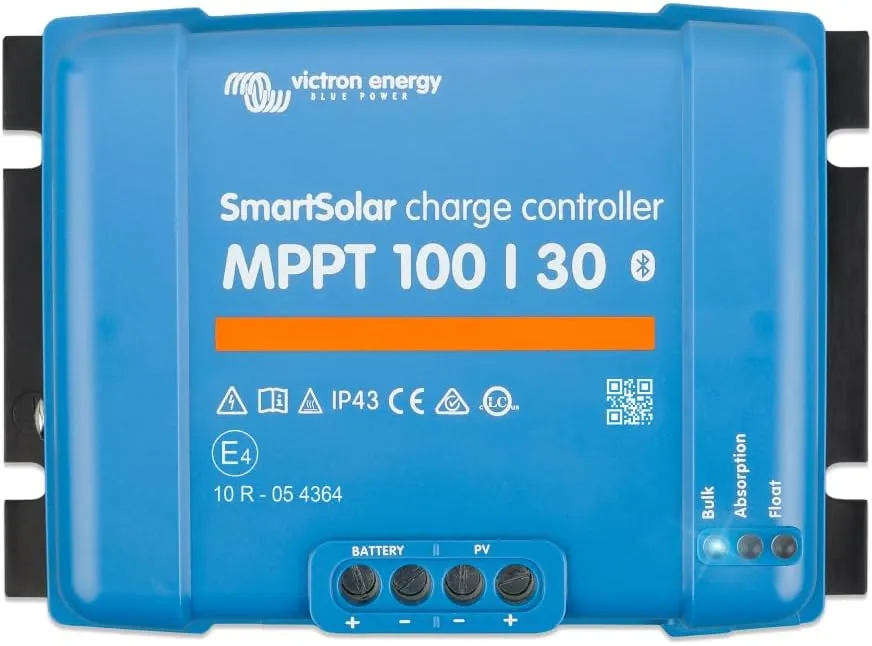
Victron SmartSolar MPPT 100/30
What I liked:
- The reference MPPT controller: tracking and charge algorithms that are genuinely better, not just better marketed
- Built-in Bluetooth and the VictronConnect app, with 30 days of history rather than a live readout only
- Handles partial shading far better than PWM, which is the whole reason to pay for MPPT
- Multiple units synchronise, so the system scales without being rebuilt
What let me down:
- Costs several times what a budget MPPT does, which is hard to justify behind a single 100W panel
- The 100V PV input caps how many panels you can put in series
- Configuration depth is real: sensible defaults exist, but lithium setups need setting by hand
Where to buy it for the best price
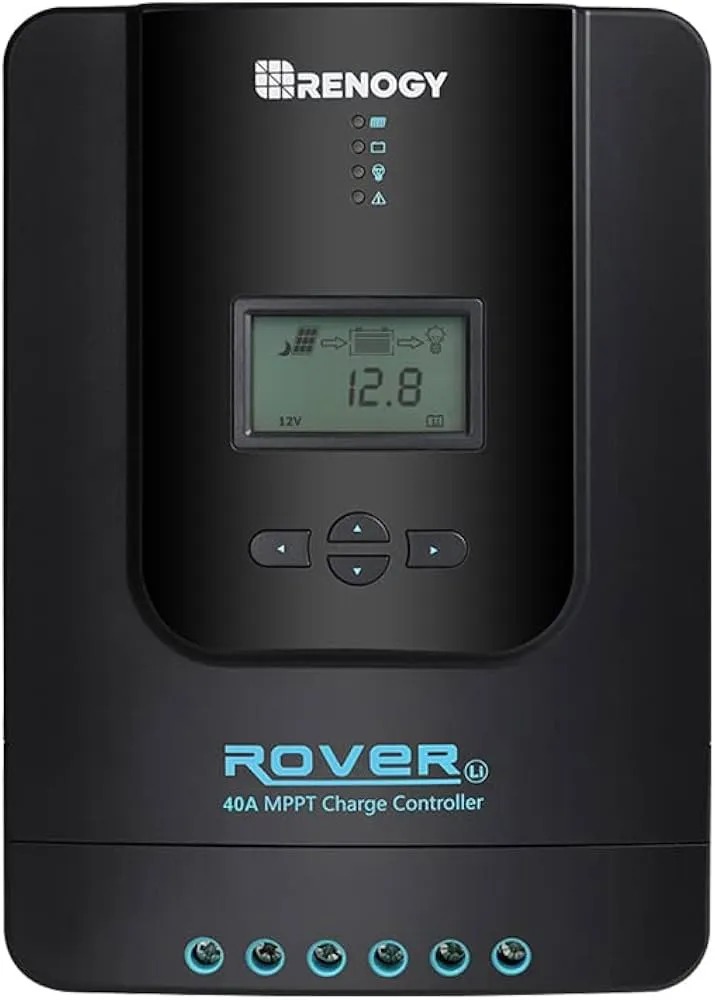
Renogy Rover 40A MPPT Charge Controller
What I liked:
- Real MPPT tracking at roughly half the price of the Victron equivalent
- 40A handles up to about 520W at 12V or 1,040W at 24V, which covers most small off-grid builds
- Bluetooth monitoring through the Renogy app, plus an on-unit LCD if you prefer no phone
- Auto-detects 12V/24V and supports AGM, gel, flooded and lithium profiles
What let me down:
- Tracking efficiency and shade handling sit a step below Victron, which is what you are paying less for
- The app and firmware are less polished, and lithium profiles need setting by hand
- No 48V support, so it is a dead end if you ever move to a higher-voltage bank
Where to buy it for the best price
Where PWM is still fine
PWM is not junk. For a tiny system, say a single small panel keeping a 12V battery topped up for a gate opener, a trickle charger, or a very small light setup, a PWM controller is cheap, reliable and good enough. If the panel voltage already sits close to the battery voltage, the efficiency gap shrinks and the price saving may be worth it.
The mistake is using PWM on a system big enough that the lost harvest, every day for years, quietly costs more than the MPPT controller you skipped.
How to decide
- System of 200W or more: MPPT.
- Panel voltage much higher than battery voltage: MPPT, no question.
- Cold climate: MPPT captures the cold-weather voltage bump.
- Tiny, cheap, voltage-matched trickle setup: PWM is fine.
- Not sure how big your system should be: work that out first in the off-grid solar sizing guide.
My rule of thumb: unless you are building something genuinely tiny, budget for MPPT and move on. The harvest you gain usually outweighs the price within a season or two, and it opens up better wiring options for the rest of the build.
The controller is one of five components, and it's the one most constrained by the others — particularly your system voltage, which is covered along with the rest of the build on the off-grid solar hub. More component face-offs are in my off-grid solar comparisons, the controllers I've actually used are in my off-grid gear reviews, and what a whole build costs is in the off-grid calculators.
Worth knowing: a portable power station has a charge controller built in, so this decision is made for you if you buy a finished unit rather than assembling one — see portable power stations.