"How many solar panels do I need to go off-grid?" has no single answer, because it depends entirely on how much energy you use and where you live. But the method to figure it out is simple, and once you know it you can size a cabin, a van, or a tiny house yourself without paying anyone.
This guide is that method, in plain terms, with honest numbers. Do the four steps and you will have a panel count and a battery size you can trust.
Who this guide is for
- You are planning a DIY off-grid system for a cabin, van, RV, shed or tiny house.
- You want to size it yourself instead of guessing or overpaying.
- You are okay with rough arithmetic. I will keep it to multiply and divide.
Step 1: Find your daily energy use (kWh/day)
Everything starts here. List every load, estimate watts times hours per day, and add it up. This is your daily energy budget in watt-hours, then divide by 1000 for kWh.
Rough daily figures:
| Load | Rough energy per day |
|---|---|
| LED lights (a few) | 0.2 to 0.5 kWh |
| Phone and laptop | 0.2 to 0.5 kWh |
| Fridge (12V or efficient) | 0.5 to 1.5 kWh |
| Water pump (intermittent) | 0.1 to 0.5 kWh |
| Fan or small vent | 0.1 to 0.4 kWh |
| Starlink or internet | 0.5 to 1 kWh |
| TV / laptop entertainment | 0.2 to 0.6 kWh |
A simple cabin or van often lands around 1 to 3 kWh per day. Add heavy or heating loads and it climbs fast. Be honest here; a low estimate is the number one reason DIY systems come up short.
Step 2: Size your panels using sun hours
Panels only produce for a handful of full-strength hours a day, called peak sun hours. This varies by location and season, roughly 3 hours in a cloudy northern winter to 6 or more in a sunny summer.
Panel wattage needed = daily energy (Wh) / peak sun hours / system efficiency
Use about 0.7 for system efficiency to cover real-world losses (wiring, controller, dirt, heat, battery round-trip). So for 2 kWh/day at 4 sun hours:
2000 Wh / 4 / 0.7 = roughly 700W of panels.
Always size for your worst realistic month, not summer, or you will be short exactly when the sun is weakest. If you live off-grid year-round, that usually means sizing for winter sun hours.
Step 3: Size your battery bank (kWh)
The battery carries you through the night and cloudy days.
Battery capacity = daily energy x days of autonomy / usable depth
- Days of autonomy: 1 day if you can tolerate running low in bad weather, 2 to 3 if you want a real buffer for cloudy stretches.
- Usable depth: with LiFePO4 you can safely use around 80 to 90%. Older lead-acid you should only use about 50%, which is one reason LFP has taken over DIY.
For 2 kWh/day, two days of autonomy, LFP at 85% usable:
2 x 2 / 0.85 = roughly 4.7 kWh of LiFePO4 battery.
Step 4: Pick the charge controller and inverter
- Charge controller: for anything but the tiniest setup, use MPPT. It harvests more and handles higher panel voltage. I break down the choice in MPPT vs PWM.
- Inverter: size it to your largest simultaneous AC load, with surge headroom for motors. If you only run DC and USB loads, you may not need one at all.
Common mistakes I see
- Underestimating daily use. The classic. Measure or overestimate rather than hope.
- Sizing panels for summer. Then freezing in the dark in December. Size for your worst month.
- Ignoring system losses. The 0.7 efficiency factor is not pessimism, it is reality.
- Using lead-acid to save money. You can only use half of it, and it dies faster. LFP usually wins over its life.
- Forgetting autonomy. One cloudy day should not black you out. Build in a buffer.
My honest take
Most first-time off-grid builders make two errors that cancel out badly: they lowball their energy use and size panels for summer. The result is a system that feels fine in July and fails in January. Do the math for your real loads and your worst month, use LiFePO4, and put an MPPT controller in the plan. Build a little margin in; running out of power off-grid is a lot more painful than a slightly bigger up-front cost.
Curious what a setup like this costs and whether it pays back versus alternatives? Try the off-grid solar payback calculator, and for the panels themselves, my notes are in the Renogy 100W review.
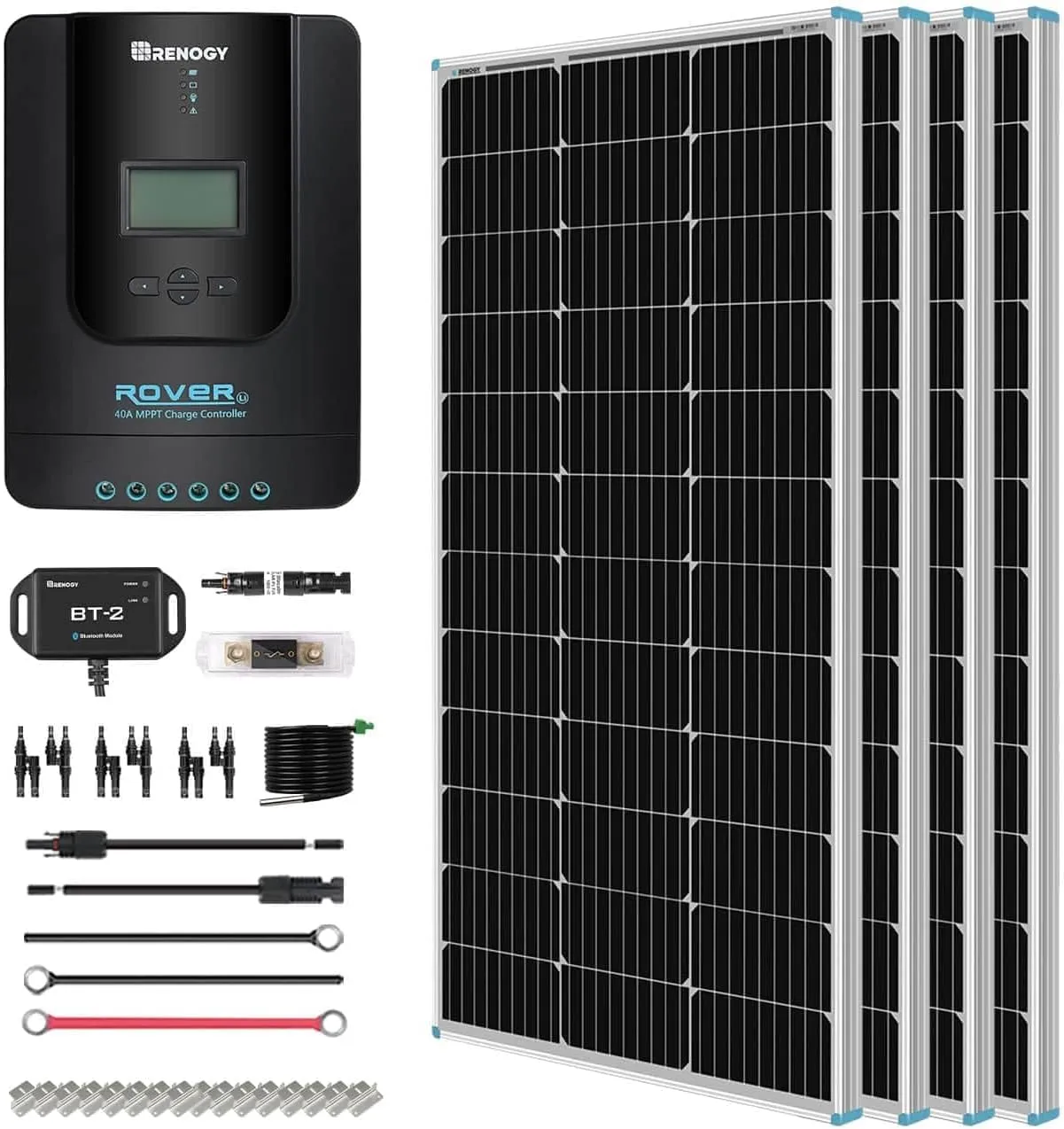
Renogy 400W 12V Premium Solar Kit
The strong points:
- 4x100W plus a 40A MPPT controller: the smallest kit that powers a realistic van or cabin load
- MPPT rather than PWM, worth roughly 20-30% more harvest from the same panels
- Bluetooth module included, so you can see production and battery state from your phone
- Brackets, fuse, adaptor kit and tray cables included: no second parts order
The weak points:
- Still no battery, and that is where the rest of the budget goes
- Four rigid panels need real roof or ground space and proper mounting
- The 40A controller caps you near 520W on a 12V system, so a bigger array means a bigger controller
Where to buy it for the best price
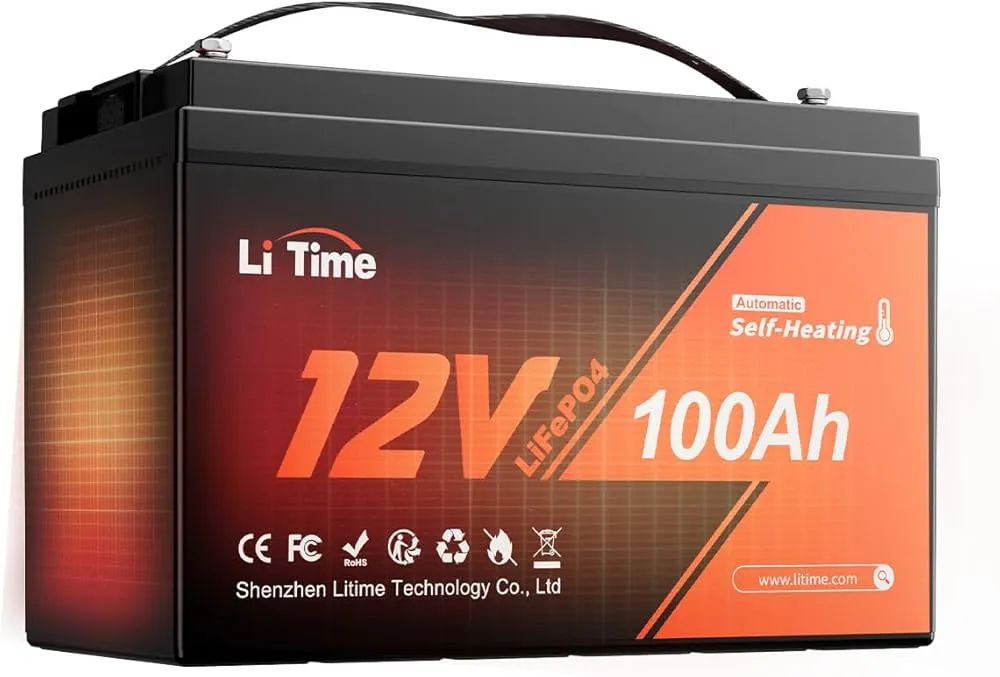
LiTime 12V 100Ah LiFePO4 Battery
What I liked:
- 1,280 Wh of storage for a fraction of what the same capacity costs sealed inside a power station
- Rated for thousands of cycles, against 200-500 for the lead-acid battery it replaces
- About 22 lb, roughly a third the weight of an equivalent lead-acid bank
- Group 31 case and built-in 100A BMS, so it drops into standard battery trays
What let me down:
- No built-in inverter or charger: this is a component, not a finished system
- Charging below freezing damages plain LiFePO4 unless you pay up for a low-temp-protected model
- You still need a charge controller, fusing and wiring, and getting those wrong is the dangerous part
Where to buy it for the best price
Once the numbers are settled, the choice that shapes everything downstream is system voltage — 12V, 24V or 48V — which is explained alongside the five components on the off-grid solar hub. More sizing guidance is in my off-grid buying guides, the gear itself in my off-grid reviews, and the scoring method in how I rate products.