I have lost count of how many people message me after buying the wrong power station. Usually it is one of two mistakes: they bought something far too small because it was on sale, or they bought a huge unit they lug around half empty. Both come from not understanding three numbers on the box.
This guide fixes that. By the end you will know exactly what size to buy, which battery type to insist on, and the traps that make cheap units a bad deal. No brand worship, just what actually matters.
Who this guide is for
- You are considering a power station for camping, van life, a home office backup, or short blackouts.
- You want something safe to run indoors, quiet, and low maintenance.
- You are tired of spec sheets that all sound the same.
Who should not bother
If you need to power a central AC unit, a well pump, or a whole house for days at a time, a portable power station is the wrong tool at any sane budget. That is generator or whole-home battery territory. See my take in power station vs gas generator.
Spec 1: Capacity (watt-hours, Wh)
Capacity is the size of your energy tank. A 1000 Wh station can, in theory, run a 1000-watt device for one hour, or a 100-watt device for ten hours. In practice you lose 10 to 15% to inverter and conversion losses, so plan for a bit less than the sticker number.
Here is roughly what different capacities cover:
| Capacity | Good for | Not enough for |
|---|---|---|
| 200 to 500 Wh | Phones, laptops, camera gear, a fan, LED lights | A fridge overnight |
| 500 to 1000 Wh | A weekend camp, CPAP machine, mini fridge, small tools | Days of fridge backup |
| 1000 to 2000 Wh | Home office backup, full-size fridge for most of a day, van life | Multi-day whole-home |
| 2000 Wh and up | Longer outages, several appliances, pairing with solar | Central AC, well pump |
The mistake I see most: buying 300 Wh because it is cheap, then discovering it cannot get a fridge through the night. Buy for the job you actually have.
Not sure which bucket you fall into? Pick your appliance and a capacity below and see the real runtime, losses included.
Runtime calculator
Cycling appliance: it only draws power about 33 % of the time (the motor stops once it reaches temperature).
Estimated runtime
≈ 1d 2h
Estimate for 1000 Wh usable at ~85 % (inverter losses + real depth of discharge). Real numbers vary with temperature, battery age, and appliance efficiency.
Spec 2: Battery cell type (insist on LiFePO4)
This is the single biggest factor in how long your money lasts, and it is the one marketers bury.
- Standard lithium-ion (NMC): around 500 full cycles before it drops toward 80% capacity. Used often, that is roughly two years.
- LiFePO4 (LFP, lithium iron phosphate): 3000 or more cycles to the same point, close to ten years of near-daily use. It is also more thermally stable, which matters for something you keep in a hot van or a closet.
My rule is simple: if the listing does not clearly say LiFePO4, assume it is the older chemistry and walk away. The small upfront saving is not worth replacing the unit in two years.
Spec 3: Inverter output (watts, W)
Capacity (Wh) is how much energy you store. Output (W) is how fast you can pull it. These are different, and confusing them ruins purchases.
You can own a big 2000 Wh station that still cannot run a 1200-watt coffee maker if its inverter is capped at 1000W. Anything that heats is the test: kettles, hair dryers, microwaves, space heaters, induction cooktops all pull 1000 to 1800 watts.
- For electronics and a fridge: 1000W output is fine.
- To run heating appliances: insist on 1500W to 2000W or more.
- Check the surge rating too. Fridges and pumps spike hard for a split second when the motor starts.
If you want to recharge from solar
Most stations can charge from solar panels, but two details decide whether it is pleasant or painful:
- Max solar input (watts). A unit that accepts 400W of solar recharges far faster than one capped at 100W. Under-spec solar input is a common way to make a "solar generator" barely solar.
- Charge controller type. Look for MPPT, not PWM, for meaningfully better harvest. I explain the difference in MPPT vs PWM.
Quick spec checklist before you buy
- Capacity (Wh) matched to your real appliances, not the sale price.
- LiFePO4 chemistry, stated clearly.
- Inverter output (W) high enough for your heaviest device, with surge headroom.
- Enough solar input if you plan to recharge off-grid.
- Enough and the right kind of outlets (AC, USB-C PD, 12V) for your gear.
Common mistakes I see
- Buying on capacity alone. A huge tank with a weak inverter still cannot run your kettle.
- Ignoring chemistry. Two years later they are shopping again.
- Over-buying "just in case." A 2000 Wh brick you never fill is heavy and wasteful. Match the load.
- Trusting "solar generator" branding. Some accept so little solar that recharging takes all day. Check the input number.
My honest take
For most people, a 1000 to 1500 Wh LiFePO4 unit with at least 1500W output is the sweet spot. It covers a home office, a fridge, camping, and short outages without being a boat anchor. Go bigger only if you have named a specific heavy load it needs to run. Go smaller only if you truly just charge electronics.
Once you have your size, the next step is picking a model. Every unit I have bought and used is written up in the reviews section, starting with the EcoFlow Delta 2 review.
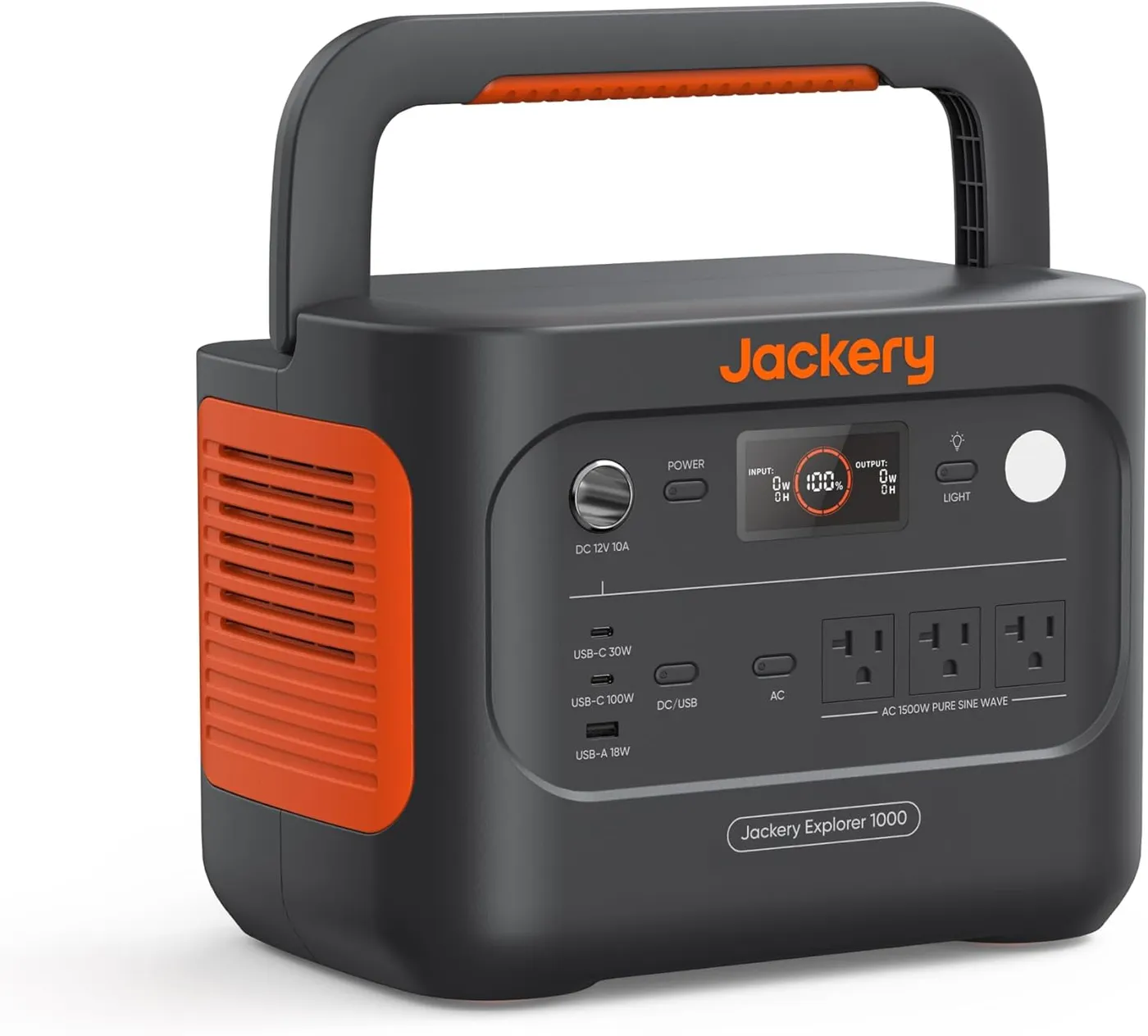
Jackery Explorer 1000 v2
What I liked:
- 1,070 Wh in a genuinely light package for the class, which is what makes it the easy camping pick
- LiFePO4 cells rated to keep over 70% capacity after 4,000 cycles
- Emergency mode charges it 0-100% in about an hour from a wall outlet
- 100W USB-C output, so it charges a laptop without running the inverter
What let me down:
- 1,500W of AC output is the lowest of the 1 kWh picks here: kettles and hair dryers are out
- Only three AC outlets, so a busy campsite runs out of sockets
- Solar panels are sold separately and Jackery's own panels are not cheap
Where to buy it for the best price
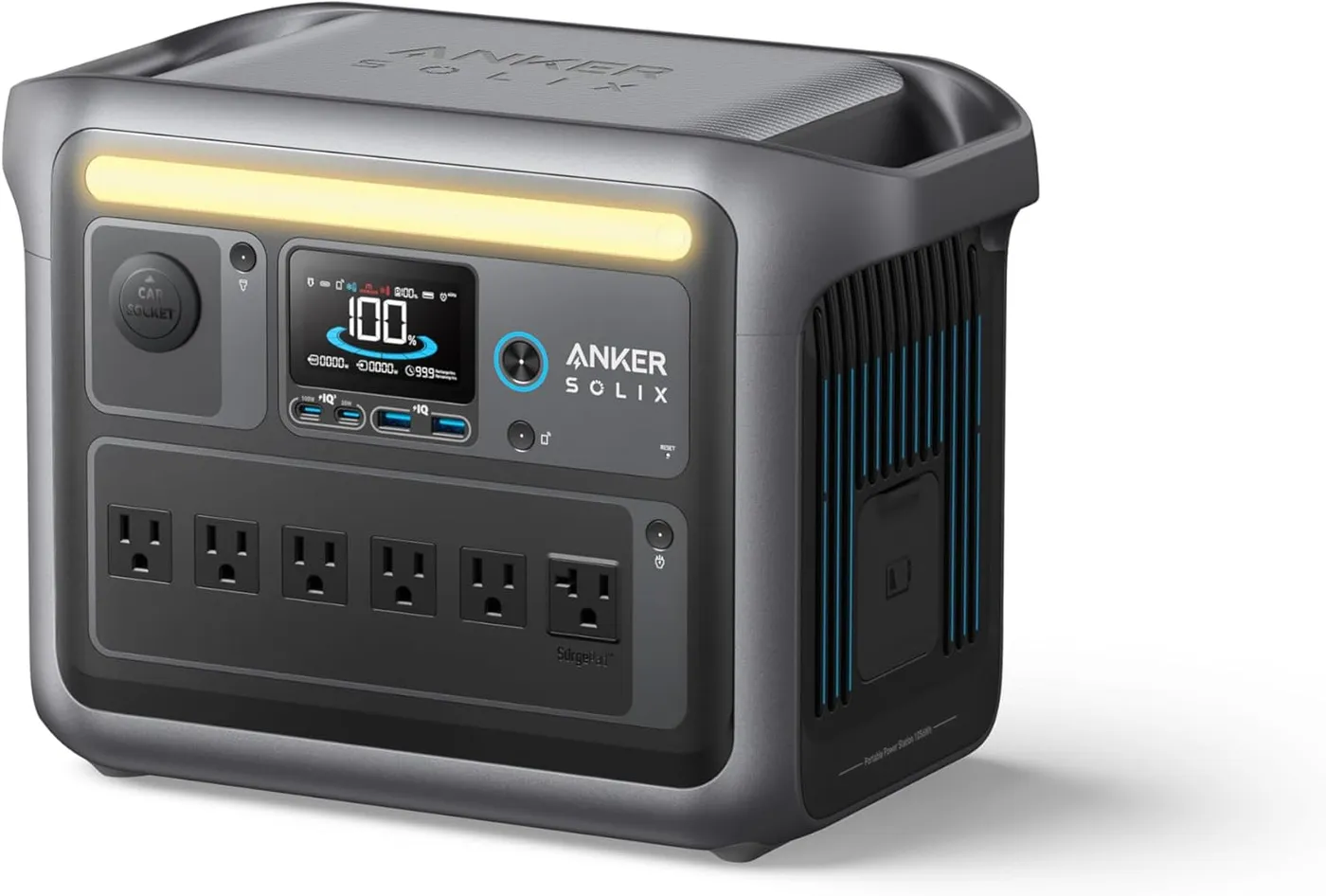
Anker SOLIX C1000
The strong points:
- 1,056 Wh and 1,800W (2,400W peak): matches the Delta 2 on the numbers that matter
- Full recharge in about 58 minutes, and 80% in roughly 43
- Expandable with a second 1,056 Wh battery if your needs grow
- LiFePO4 cells, 11 ports and a 5-year warranty
The weak points:
- Around 28 lb, so it is car-portable rather than truly packable
- Peak surge output is slightly below the Delta 2's
- You get the most out of it by staying inside Anker's ecosystem for expansion and panels
Where to buy it for the best price
Where to go from here: the size bands and the terminology behind them are laid out on the portable power station hub; the rest of my step-by-step guidance is in my portable power buying guides; and if you're still weighing this against fuel-based backup, all my portable power comparisons start with that question. Scores on the boxes above are explained in how I rate products.